

By Ian Duncan
In the last chapter, we unpacked the CEO’s change equation:
Momentum = Mass × Velocity (P = MV)
Where
Mass = how many people and priorities you can get moving together
Velocity = whether they’re all moving in the right direction
It’s the simplest formula for transformation and the reason so many transformations stall.
Not because CEOs lack ideas. But because organizations lack direction of travel.
And that direction begins with your first and often most misunderstood lever of change: Purpose.
The problem is that “purpose” has lost its sharpness. It’s become a buzzword. A line on the “About Us” page. A well-meaning promise about “making the world better.” Something added to please Millennials and Gen Z rather than mobilize the entire enterprise. No wonder employees roll their eyes.
But real Purpose defined with ambition and grounded in the business is something very different.
It’s a mindset shift. A leadership signal. The spark that helps move an organization from product-centric to growth-centric. And it’s the first place where momentum actually begins.
Because Purpose isn’t about what you make.
It’s about why you exist and what you’re capable of becoming next.
When Purpose works, it does four things:
- It connects directly to your ambition.
Not Corporate Social Responsibility optics. Not marketing language.
A clear picture of the business you want to build and the path to get there. - It gives people “skin in the game.”
Employees don’t rally around platitudes.
They rally around a future they can see themselves shaping. - It shifts mindset from “what” to “why.”
From outputs to impact.
From internal thinking to customer-centricity.
From siloed work to shared meaning. - It crystallizes into a simple, memorable Big Idea.
A north star.
A story employees remember.
A story customers feel.
A story the market believes.
And when that happens, Purpose becomes the CEO’s instrument of soft power, the emotional accelerant that gives your transformation momentum before a single process, structure, or system changes.
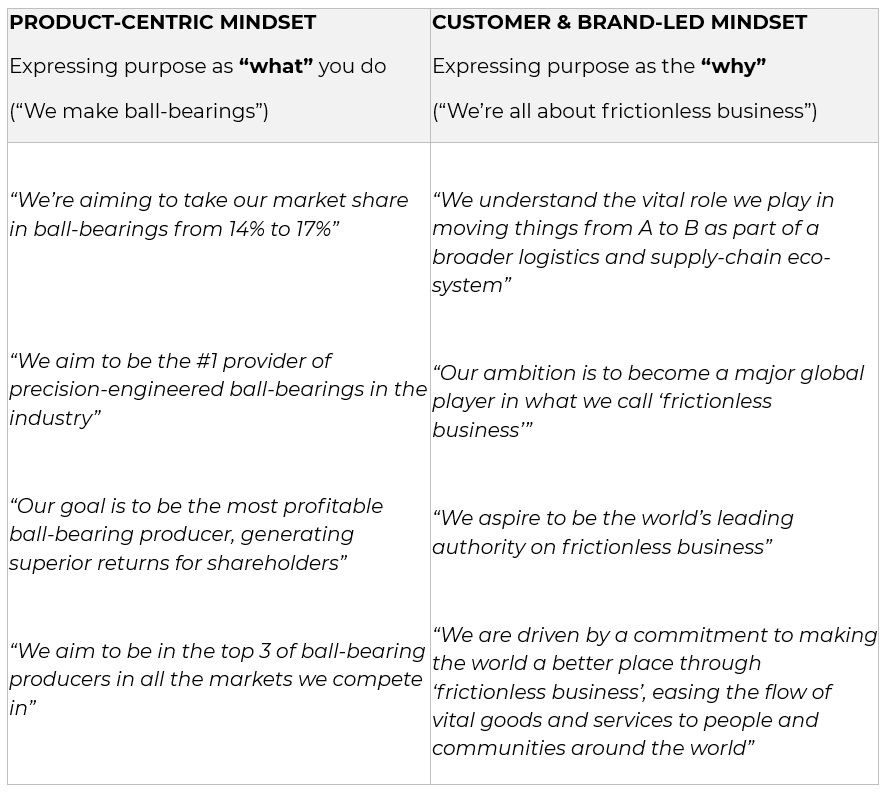
A ball-bearing manufacturer proved this.
For years, they defined themselves by what they produced.
Ball-bearings. A commodity. A category with limited room to grow.
A new CEO reframed everything.
She shifted the story from “We make ball-bearings” to “We create frictionless business.”
Suddenly, the company wasn’t in a product category it was in the business of enabling the global flow of goods.
That one shift didn’t just change strategy. It changed people.
It gave them confidence, pride, and a future they could help build not merely a product they needed to defend.
Momentum followed.
Creating a different story for a ball-bearing Co
Your Purpose can do the same, if you let it.
If it’s tied to your ambition.
If it’s believable to your people.
If it’s simple enough to remember and big enough to inspire.
If it becomes the idea that anchors every change initiative that follows.
Because when your organization understands why it exists, it finally knows where it’s going and that’s when real transformation begins.
Follow the Series
The subject of this series of short articles is how CEO’s can use their corporate brand as an asset in helping them succeed in transforming and growing their organization. Use of brand in this context is a missed opportunity, and one which has never been more relevant. The series covers why CEOs need help today, what they need help with, how brand fits in, how to deploy brand to do its job, and how to get started on the journey.
What brands can do for CEOs–Putting your brand to work
The CEO-s Change Equation for Brand Growth Momentum: P=MV
Purpose — The CEO’S First Lever of Momentum (this article)