

by Ian Duncan
The restaurant where nobody wants to eat
Imagine walking into a restaurant where, instead of a menu, you’re handed a list of 1,500 ingredients and told to construct your own meal. Exhausting, right?
Yet this is exactly how too many B2B organizations present themselves to the market. They’re so caught up in their own product and organizational complexity that they make it harder not easier for customers to buy from them.
How crazy is that.
Your platform is probably leaving money on the table
With growth top of your agenda, you need your business platform working as hard as possible. But it may not be making growth easy if:
The market can’t make sense of your proliferation of products and services that have grown like “weeds” around your internal org structure. Your own people can’t articulate the full range of value you offer.
Your offering isn’t aligned with the customer needs growing most strongly. Sales struggle to hold on to accounts.
Opportunities for bundling products into broader offers are apparent but never happen because it would disrupt the organizational status quo.
Your value articulation is indistinguishable from competitors and riddled with jargon that obscures what you actually do.
Sound familiar? You’re working twice as hard to grow because you’re one of your own competitors.
It’s a mindset problem
The issue isn’t your products, it’s how you think about value.

Same business. Completely different platform for growth.
When organizations wake up: The Unilever example
Sometimes companies realize the problem is how they’re organized. Unilever overhauled its complex matrix model, moving from three divisions and 15 performance management units to five business groups (beauty & wellbeing, personal care, home care, nutrition, ice cream).
CEO Alan Jope’s reasoning? “This change will make Unilever simple and agile with greater empowerment and accountability.”
Translation: We’re going to make it easier for customers to buy from us.
The ball-bearing transformation
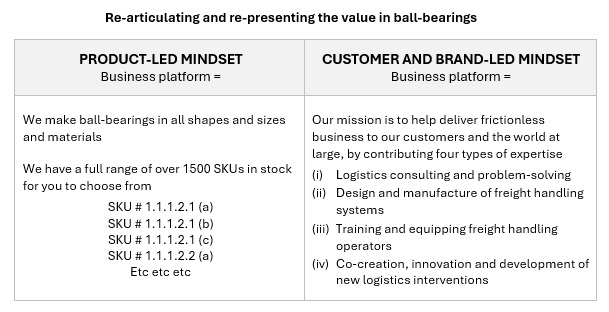
Back to our ongoing example. The CEO is moving away from a product focus that made a virtue of holding 1,500+ SKUs, to four distinct but complementary offers tied to the “frictionless business” idea:
Re-articulating and re-presenting the value in ball-bearings
The four offers may eventually become business units with their own P&L. But that’s not the start point. First, she wants people thinking beyond the org structure and becoming Brand ambassadors who can articulate the full breadth of value.
The brand opportunity
Brands are good at “making the whole greater than the sum of the parts.”
Your opportunity is using Brand as the organizing idea to start the re-configuring process better, aligning how you present capabilities with customer needs, tied to your vision and purpose.
This means:
- Changing the internal conversation about what “value” means from both internal and customer perspectives
- Re-conceiving your offer to the market
- Identifying practical quick-wins (website representation, pilot campaigns aligned with new offers)
- While simultaneously redesigning your organizational model to deliver sustainably
The uncomfortable truth
We don’t live in a perfect world. If your business is organized around products and you can’t change that medium-term, find workarounds to execute a customer-led approach in spite of the operating model.
Your corporate website is one channel. Even the most insanely matrixed organizations can present a relatively untangled view of their offer to the outside world.
But ultimately: The job of your business platform is to make it easier for customers to buy more from you. It’s that simple.
If it’s not doing that, you’re fighting with one hand tied behind your back.
This series is about deploying corporate brand to drive transformation and growth. That starts with changing mindset as your foundation.
In previous articles, we explored purpose and customer as the first two levers for changing organizational mindset. Now we turn to the third: business platform, using brand to present your offer to the outside world in a way that supports capturing a greater share of value for your organization.
Follow the Series
The subject of this series of short articles is how CEO’s can use their corporate brand as an asset in helping them succeed in transforming and growing their organization. Use of brand in this context is a missed opportunity, and one which has never been more relevant. The series covers why CEOs need help today, what they need help with, how brand fits in, how to deploy brand to do its job, and how to get started on the journey.
What brands can do for CEOs–Putting your brand to work
The CEO-s Change Equation for Brand Growth Momentum: P=MV
Purpose — The CEO’S First Lever of Momentum
Addressing the Mindset Challenge, through Customer
Addressing the Mindset Challenge through Business Platform (this article)