

by Sara Donida
Building World Cup brand value is a unique opportunity for companies. It isn’t the value of the teams’ brands but the value of the product brands sponsoring them.
The World Cup is THE biggest sport event globally, with billions of eyes glued on the same 104 matches over 39 days; 3 host countries, 16 venues, 48 national teams up from 32 in prior years. More teams means more matches, and more matches (along with the new hydration breaks!) means more broadcast windows, more sponsor placements, and more digital content, all of it compounding into greater brand value growth potential.
There was almost a 100% attendance at the stadiums for the initial group stage matches, with more than 64,000 spectators per match drawn from 210 countries and territories. Fan Festivals outside the stadiums for those who couldn’t afford tickets added over 5.5 million visitors during the group stage alone, pulling tourism, hospitality, retail, and live music into the tournament’s economic orbit.
Scale like this does not just multiply sales. It multiplies the speed at which brand value is won or lost. Different product brands are trying to profit from the World Cup and build brand value in different ways. Let’s take a look at them to find out how this works.
Three strategies companies are using to build World Cup brand value
- Official World Cup partner: Buy exclusivity and institutional legitimacy.
- Official country team sponsorships: Buy local relevance, fan allegiance and wider fame if the sponsored teams win.
- Ambush marketing: Dream up unofficial and unorthodox ways of creating brand presence without paying for it
Let’s take a look at each.
1. Building Brand Value through Official Partnership – Adidas
Adidas is FIFA’s global official partner, the highest and most exclusive commercial status the tournament offers: it grants access to FIFA trademarks, in-stadium advertising, hospitality programs and, crucially, protection under the Clean Stadium policy, which removes competing brands from official tournament spaces.
Adidas’s goal isn’t just to sell products, but to reinforce a positioning built on authenticity, tradition and a century-long bond with football.
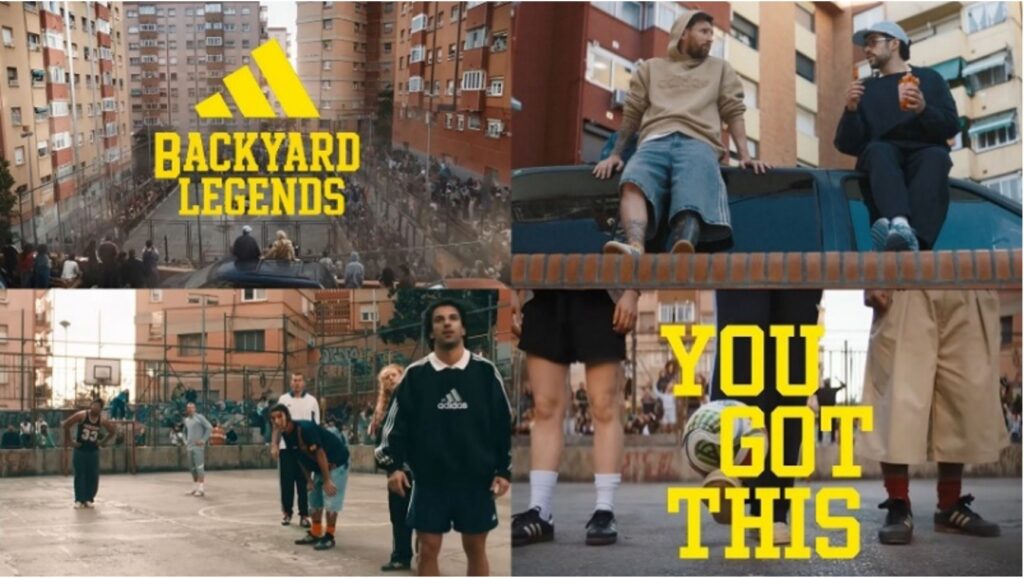
As part of its FIFA World Cup activation, Adidas launched Backyard Legends | The Greatest Football Story Ever Told, a campaign narrated by Timothée Chalamet with Bad Bunny, bridging sport and pop culture. The campaign brings together past icons, such as Zidane, Beckham and Del Piero, with current stars such as Messi, Bellingham, Yamal and Trinity Rodman, framing football as a universal ritual passed down through generations.
That positioning also plays out on the ground. Adidas has been the official match ball supplier since 1970. The latest ball developed by Adidas, Trionda, is a “connected-ball” fitted with 500 Hz sensors that help identify ball touches for FIFA’s semi-automated offside system, putting Adidas technology literally at the center of every match. Beyond the pitch, Adidas built “Home of Soccer” fan hubs in eight North American cities, from Brooklyn Bridge Park in New York to STACKT Market in Toronto, combining free match screenings, concerts, retail drops and boot try-ons into a physical brand experience.
2. Building Brand Value through Team Sponsorship – Nike and Puma:
Another way to build World Cup brand value is to get closer to the fans by sponsoring national teams. Brands can provide the kits and feature sponsored teams and players in ads and events. Adidas sponsors not only FIFA but also the kits for 14 national teams including prominent ones such as Argentina, Germany, Spain, Belgium, Morocco, and Mexico. While Adidas bought institutional exclusivity, Nike and Puma took the different path of only sponsoring about national teams—about a dozen each—and creating focused marketing around teams and star players.
Nike
Nike sponsors 12 national teams instead of an official FIFA sponsorship, hoping to get greater financial returns by marketing deeper around the teams, and tapping into fan allegiance. Among Nike’s sponsorships are many of the world’s strongest football federations, including Brazil, France, England, Portugal, the Netherlands.
The new CEO Elliott Hill, brought back from retirement to lead a Nike turnaround, is refocusing the brand away from direct and digital, and back to being the world’s best sports brand. He is putting sports back at the center, not lifestyle and fashion.
The World Cup is perfect for this effort. It gives Nike a global showcase for brand storytelling and innovation.
Rather than football as heritage to protect, Nike makes football central to celebrity culture. Its advertising is all about linking the two. For the first time, Nike has as many or more stars than Adidas. In Rip the Script, Nike’s flagship FIFA World Cup campaign, Nike presents football stars such as Ronaldo, Mbappé, Haaland and Vinícius Júnior, alongside stars from other sports, and entertainment and cultural icons. Putting the football stars together with Travis Scott, Kim Kardashian, LeBron James, Lisa of Blackpink, Serena Williams, Channing Tatum and Jason Sudeikis, who have nothing to do with football, positions football within the broader star-studded entertainment economy.
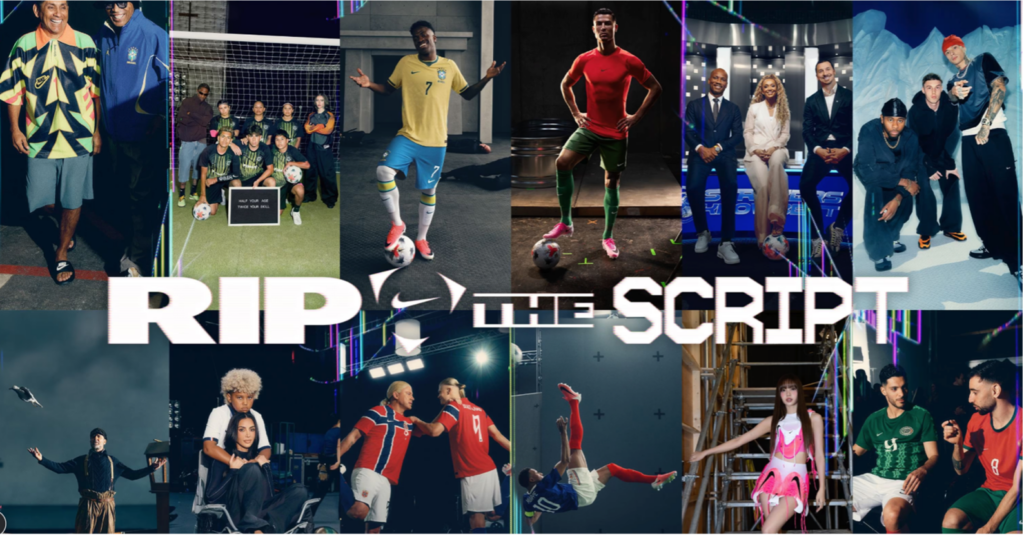
Here’s what Nike says about the campaign: “More than a film, ‘Rip the Script’ is a gateway to an unfolding universe of Nike Football that moves at the speed of culture: fast; layered; remixable; and alive across sport, entertainment, music and fashion.”
While Adidas leans on FIFA’s institutional reach, Nike leans in on individual star power. Its roster includes several of the tournament’s most prolific scorers. The brand staged its biggest product launch in years for the tournament’s opening week. It created two new performance platforms, splitting up Superfly and Vapor, each boot optimized for a different type of speed. The boots appeared on the feet of Nike-sponsored football stars—Kylian Mbappe launched the Mercurial Vapor 17 in France’s opening World Cup match, Vinícius Júnior wore it in Brazil’s first match, Cristiano Ronaldo wore the Superfly 11 in Portugal’s opening match.
Will Nike’s sponsorship focus on on-pitch innovations and localized expressions of football culture prove more profitable than Adidas’ global sponsorship?
Puma
Puma too has a new CEO, Arthur Hoeld, charged with a company turnaround. He’s sponsoring 11 national federations but taking a different approach. The brand has adopted a targeted geographic strategy. Puma’s marketing is focused on Africa. Five of its 11 partner teams (Ghana, Senegal, Ivory Coast, Morocco and Egypt) are African.
Rather than ads, Puma has gone all-in for street-level marketing. Puma’s new shirts were unveiled not at a traditional press event, but in the streets of New York City. 11 branded trucks, each representing one of its 11 sponsored nations, with its own music, food, and cultural activations, drove through the streets of New York, converging on Domino’s Square. Players from the local community wore the jerseys for the first time in live matches under the Williamsburg Bridge. Puma also made a custom boot for US vice-captain Christian Pulisic designed in partnership with Brooklyn label KidSuper.
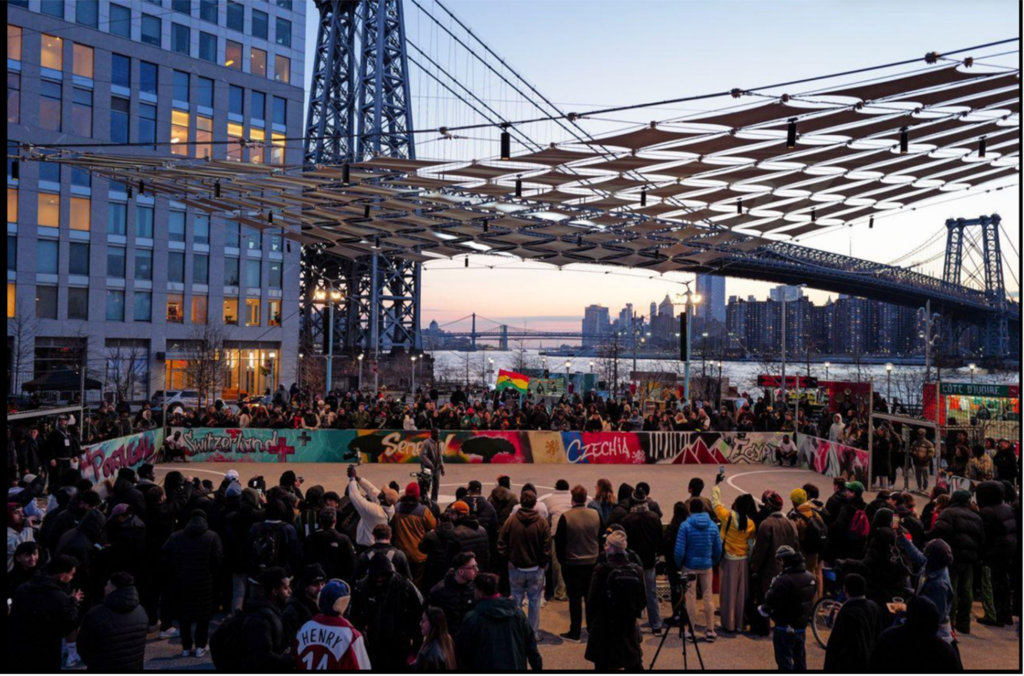
In contrast to Nike, Puma is positioning football as local culture and accessible, rather than star-studded entertainment and top performance. It’s a challenger brand strategy focused on emerging nations and a local approach.
3. Building Brand Value through Guerilla Marketing – Levi’s, Gillette, Heinz
The tournament’s most striking brand-value story belongs to brands that were not part of the sponsorship program and stole association with the World Cup by unorthodox and highly creative methods. World Cup guerilla marketing has paid off for some brands.
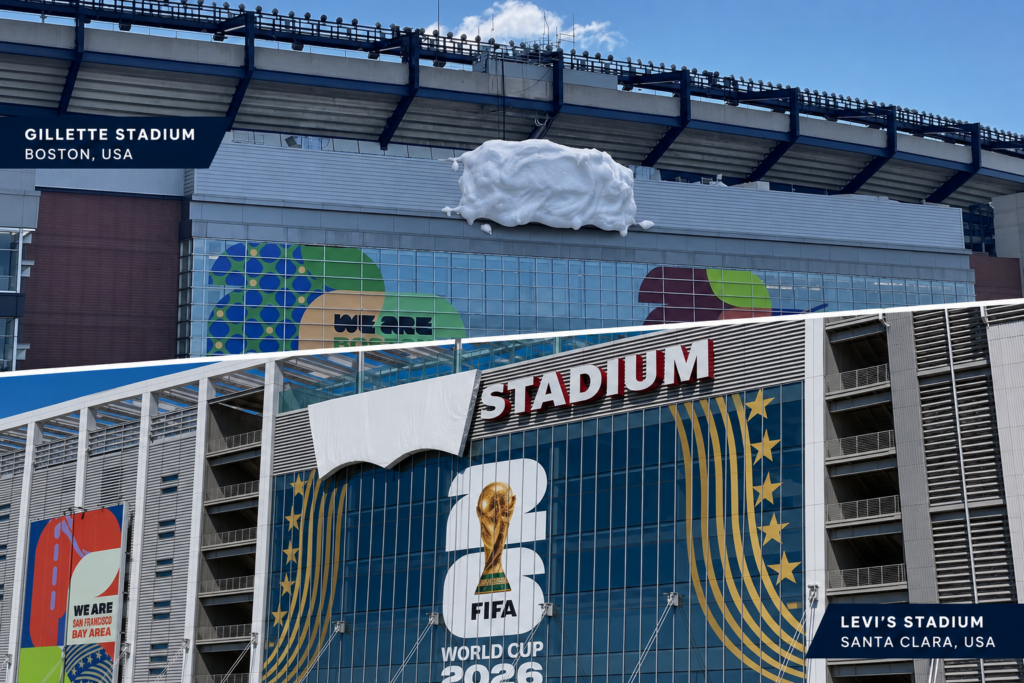
Levi’s started it. FIFA’s Clean Stadium policy forced all stadiums to temporarily drop their stadium naming sponsors and change their names for the duration of the tournament. Levi’s Stadium in Santa Clara was renamed “San Francisco Bay Area Stadium.” The stadium was forced to drape the giant red Batwing logo on its façade in a plain white tarp shaped to match its silhouette. This backfired spectacularly. The tarp didn’t hide the logo, it outlined it.
Levi’s seized on the opportunity to create a tremendous amount of earned media. It swapped its Instagram and TikTok profile pictures for mock-ups of the covered logo, captioned “Welcoming the world to the beautiful [redacted] stadium!” over the viral “Nobody’s Gonna Know” audio. It extended the joke to its own storefronts in Paris, London and Hong Kong, draping them in the same white sheet treatment as the stadium. Then, the brand went a step further and put the moment up for sale: a limited-edition “Nobody’s Gonna Know Logo Tee”, turning the meme into merchandise.
Other brands caught by the same rule jumped on this idea. Gillette stadium was forced to rename itself Boston stadium. Gillette retaliated by slathering its logo with shaving foam, instead of covering it with a tarpaulin.
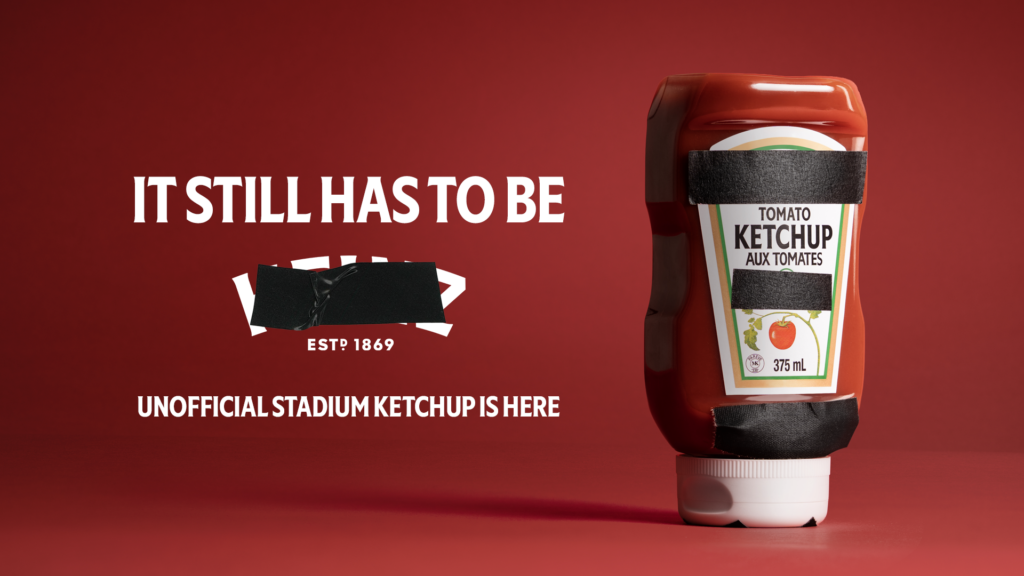
FIFA required stadium concession Heinz bottles to be covered with black tape, because they are not an official sponsor. Heinz embraced the restriction instead of hiding from it and actively posted images of its iconic bottles wrapped in black tape on social media. Building on the buzz of the blacked-out bottles, Heinz introduced a limited edition “Unofficial Stadium Ketchup.”
How Does Association with FIFA Build Brand Value?
The FIFA World Cup is one of the few global platforms which can simultaneously build mental availability, emotional resonance, brand credibility, and sales growth. The three different strategies to build World Cup brand value has worked for the brands that used them.
How does World Cup brand value building happen? Here is how it works, in rough order of importance:
- Mental availability: puts the brand into billions of conversations, increasing awareness and likelihood that the brand will pop into people’s heads at the time of purchase
- Emotional resonance: the World Cup is more about national identity, pride, belonging and shared emotion than it is about sport
- Brand credibility: the World Cup is global and big—being associated with it implies that a brand has scale and is successful
- Sales growth: the World Cup can create sales when it is associated with specific products, particularly sports apparel, but the World Cup is more important for lasting brand building than it is for immediate sales
How Have These three Strategies Worked to Build World Cup Brand Value?
Here is a deeper look at each brand value building lever.
Mental availability:
Each of the three strategies has increased mental availability for the brands pursuing them, simply because of the number of times they have been seen. But perhaps the biggest mental availability winners are those who created the biggest conversations. These are also the brands that will have generated the greatest ROI. FIFA Tier 1 sponsorship investment is $100-$150 million. Levi’s, Gillette and Heinz didn’t spend a penny on sponsorship.
The lack of spend didn’t matter. Levi’s engagement has nearly quadrupled since it started the stadium cover-up. Brand mentions have risen 44% since the tournament began. Levi’s posts about the “beautiful [redacted] stadium” have racked up more than 90 million views on Instagram.
Gillette did even better with its stadium cover-up, generating 383 million online mentions compared to 153 million for Levi’s. Gillette’s net sentiment was strongly positive: +43.
Heinz is one of the most talked about marketing wins of the World Cup. Earned media impressions are estimated at 100-500 million, 100-300 news and trade articles have been published, and there are hundreds of thousands of social engagements ongoing.
| Brand | Estimated social reach | Earned media value |
| Levi Strauss & Co. | 15–30M | $8–15M |
| Gillette | 5–15M | $3–7M |
| Heinz | 8–20M | $4–8M |
Attempts to conceal information make it more visible, creating curiosity, generating worldwide press coverage, millions of social impressions, and reinforcing brand equity.
Emotional resonance:
The emotional power of the World Cup ambush campaigns came from the story they created. They turned an act of exclusion—having their logos covered under FIFA’s clean stadium rules—into a narrative that people wanted to share. That’s why there has been so much earned media and discussion.
For Levi’s, the emotional trigger is defiance and cultural confidence, the idea that you can hide our logo but not our identity.
For Heinz, it is humor and absurdity. Heinz’ campaign probably creates the strongest joy. By releasing its own Unofficial Stadium Ketchup, Heinz invites consumers to laugh with the brand. Humor works particularly well because it increases sharing—people enjoy forwarding jokes to friends.
For Gillette, the emotional trigger is cleverness and wit. Transforming the cover-up into shaving foam reinforces the brand in an elegant way. It isn’t laugh-out funny, but creates appreciation, delight in the metaphor, and admiration for the brand’s creativity. It is the type of advertising that makes people think, “that’s smart” and enhances perceptions of the brand.
For Adidas, the association with FIFA reinforces football heritage and credibility. Adidas is celebrating football tradition, supporters, community, national pride and shared experience.
Nike’s resonance goes back to the original concept of “Just Do It”—the idea of the athlete inside you, that anyone can be an athlete. Its marketing celebrates greatness, confidence, individual brilliance, energy, the excitement of big moments. It is inspirational, reinforcing the idea that football is about ambition and possibility.
Puma’s emotional resonance is all about being the challenger brand and emphasizing enjoyment. It leans into creativity, local culture, fun, accessibility, and youthful energy. It resonates well with Gen Z which values experiences over prestige.
Brand credibility:
Adidas, Nike and Puma are building category credibility, strengthening the belief that they are genuine football brands.
Adidas is the gold standard for football credibility. The World Cup reinforces what consumers already believe—that Adidas is football. Decades of uninterrupted association have made Adidas the brand most strongly associated with football authenticity.
For Nike, credibility is all about winning. Nike builds credibility by sponsoring winning teams and iconic players—the idea that the best players choose Nike. Nike leans on the authority of the athletes, not FIFA. When Nike-sponsored teams win, perceptions of innovation and performance strengthen.
Puma’s brand credibility is about being culturally authentic, creative, and connected to emerging football nations. Puma is trying to embed itself in football communities.
Levi’s, Heinz and Gillette are building cultural credibility. They demonstrate that they understand the moment and can participate in football culture without needing to sell football products.
Levi’s is communicating that it is culturally connected and fashionably relevant. Heinz is reinforcing its image of a brand with personality—culturally-savvy, playful and understands popular culture. Gillette’s clever cover-up plays to the brand positioning of precision and sharpness, being in the moment.
Sales growth:
Data for Levi’s, Gillette and Heinz sales for the World Cup period are not yet available. But for these brands, it’s not about sales. It’s about building lasting brand equity, which in turn will drive preference and sales.
For Puma, too, it’s about brand rebuilding rather than selling World Cup merchandise. The brand is at an inflection point. Puma faces major challenges—loss of desirability and momentum vs. Nike and Adidas as well as new competitors. Sales were down 8% in 2025. Puma describes 2026 as a transition year, focused on rebuilding growth. Football apparel revenues are performing strongly in 2026, supported by sales of the kits of its qualifying World Cup teams. But it’s not the sales, it’s the bigger brand-related issues that Puma cares about.
For Adidas and Nike, the World Cup is about increasing both sales and brand equity. The duel between Nike and Adidas can be seen as a major World Cup match. Nike has far more to gain. Adidas is the established leader in football; Nike is clawing its way back after years of decline. So far, both are neck and neck in terms of communications activation. They have about the same number of teams. Both are doing star-studded high-cost ads. Both have been running street games in NYC. But two different strategies—for Adidas, football heritage and credibility, and for Nike, ambition and possibility.
Which will win?
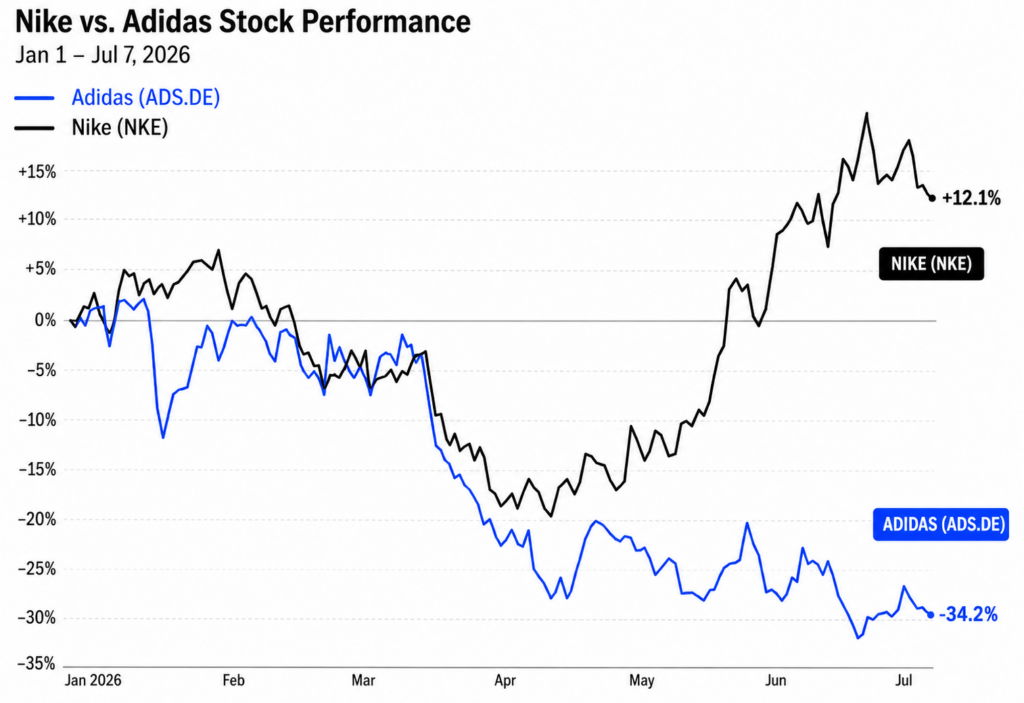
So far, it looks like Nike. Nike is generating higher revenue and earnings growth, selling out merchandise at 4x the rate of Adidas, while charging a price premium–that is the way to build World Cup brand value.
| Metric | Adidas | Nike |
| Teams Sponsored | 14 | 12 |
| Expected Revenue Growth | -1.7% | 6.8% |
| Expected Earnings Growth | -6.1% | 22.2% |
| Merchandise Sell-Out Rate | 7% | 28% |
| Average Jersey Price | $95 | $125 |
| Stock Performance YTD | 3.8% | -35.6% |
| Source: Barron’s |
Building Brand Value beyond the World Cup
To build World Cup brand value gives brands a tremendous immediate boost. But the business of both companies is much bigger than World Cup products. Nike’s stock has lost ¾ of its value since late 2021, not helped by new competitors On and Hoka. Since a late March low, Adidas stock is up 36%, while Nike’s shares are down 20%. World Cup sales are just a small part of Nike’s business. Nike’s challenge is to restore the brand and bring back innovation.
The biggest win may be off the pitch. For the first time in 70 years, the German national team will not wear the Adidas logo in the next World Cup. Instead, the jerseys will feature the Swoosh, a move that has triggered public and political backlash in Germany. Nike has used this to take a jab at its rival, sailing a barge down the Hudson as the German team played in New Jersey. On barge stood German star Jamal Musiala in a pixelated jersey that covered up its logo, captioned, “Coming Soon.”
The World Cup contribution to rebuilding the Nike brand is much more critical than immediate sales and likely to generate greater returns.
Brand marketing that generates more sales, profit and financial value growth than any immediate sales from products build brand value over the long term.