Stop optimizing for a funnel that has already moved.
The latest consumer and B2B buying data points to a hard, irreversible pivot: the majority of purchase decisions now start inside a GPT or LLM, not on a brand’s website, and not on Google. Buyers are skipping the top of funnel entirely. They open a chat window, ask for a shortlist, and let AI do the filtering.
According to recent data, over 50% of consumers now use generative AI to support purchase decisions. For B2B procurement teams, AI isn’t a novelty, it’s the default first stop for vendor discovery.
AI doesn’t browse your website the way a human does. It synthesizes, it summarizes, and it acts as a ruthless gatekeeper. If your brand isn’t in the top two or three names an LLM generates in that first response, the consideration set is closed. The buyer never clicks. They never see your case studies, your pricing, your landing pages. The deal is won or lost inside a chat interface without the need to create awareness at the upper levels of the funnel.
Six questions. Most brands can’t answer any of them.
| KPI | The Question | The Consequence of Not Knowing |
| AI Share of Voice | If a buyer asked ChatGPT, Perplexity, or Gemini to name three brands in your category — would yours be one? | Whether you’re fourth or below doesn’t matter. You’re not there. And no one on your team can tell. |
| AI Sentiment Score | When your brand does show up, is it being framed to win — or hedged, compared unfavorably, positioned as the fallback? | AI may be finding you and you may still lose the sale, time after time. |
| AI Recommendation Rate | When a buyer asks AI to actually choose — not list options, choose — does your brand get picked? | Brands routinely score well on visibility and sentiment and still not be picked: seen everywhere, chosen nowhere. |
| AI Purchase Driver Intelligence | Which brand does AI think performs most strongly on the purchase drivers that matter in your category? | AI may think a competitor’s brand outperforms yours on the most important purchase drivers, and you may be none the wiser. |
| AI Brand Fingerprint | How does AI think your brand is positioned, and does that match the positioning you want to communicate? | AI can misinterpret your brand and fabricate a different story, without you having any idea of this. |
| AI Citation Rate | Which sources is AI pulling from to describe your brand — and which sources is it using for your competitors? | You can’t fix your content and marketing roadmap, if you don’t know what sources AI is using. |
The cost of not knowing
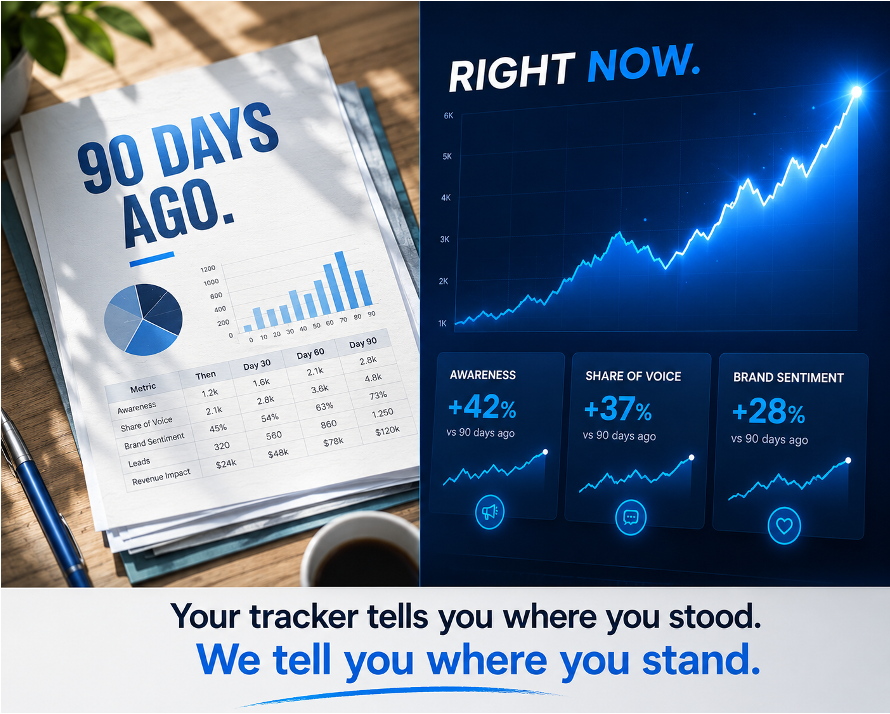
All of these six blind spots are real, yet none of them show up on your existing dashboard. Your brand health scores will look fine. Your tracker will show stable awareness. Meanwhile, the fastest-growing decision channel in the history of marketing may be forming a different view of your brand — and you don’t know this.
Being outside the top three in AI isn’t ranked fourth. It’s invisible.
If you don’t know, your brand is already at risk
This isn’t a “nice to have” addition to your brand measurement system. It’s the layer where your buyers are deciding, and right now you have no visibility into any of it.
Presciant’s AI brand measurement is the first model built specifically to answer all six questions. It shows you what is happening in AI: AI Share of Voice, AI Sentiment Score, and AI Recommendation Rate. And it can reveal exactly why and what to do about it: AI Purchase Driver Intelligence, AI Brand Fingerprint, and AI Citation Rate. Across every major AI platform. Benchmarked against your competitive set. In real time, not backward looking. At your fingertips, not quarterly.
The danger is critical: established category leaders — brands that dominate traditional search — are losing the AI recommendation when it actually counts. And the opportunity is real for new and smaller brands who may rise to top of AI choice before you realize it.
If you’re a CMO, VP of Marketing, or Brand/Insights lead and you don’t have a data-backed answer to “what is ChatGPT, Claude, and Gemini telling our buyers about us right now” — that’s not a gap you can afford to leave open. Every week it stays open is a week your competitors may already be closing it.
Book a 30-minute discovery call. Get in touch with us.