

by Sandeep Vasudevan
We are witnessing the rise of a new digital frontline: The AI marketing agent is your new brand ambassador.
This shift in the digital landscape is as fundamental as the transition from desktop to mobile, but with a critical difference: The customer interface is no longer a passive website or search bar. It is becoming active, autonomous, and conversational. When an AI marketing agent speaks to your customer, it is your brand that controls the voice, the tone, and the decision-making process.
The global market for these agents is projected to skyrocket to over $103 billion by 2032. But while the C-suite fixates on efficiency and IT focuses on integration, a critical danger lurks in the blind spot: Brand equity.
Here we discuss why deploying AI marketing agents without strategic rigor is a reputational risk. You will learn the framework for designing AI brand ambassadors that build value rather than destroy it.
Does your AI marketing agent reflect your brand?
In this nascent stage, many companies are treating AI agents as utility pipes rather than brand touchpoints. The result is a fragmented ecosystem where a customer might encounter a helpful, witty agent on the mobile app, a robotic and cold agent on the website, and a confused, hallucinating agent in the support queue.
This failure to think about brand creates a dissonant experience. Brands spend millions crafting a voice of the customer and a brand identity system, only to hand the microphone to a stochastic model trained on the open internet.
The AI agency “Frankenstein” problem
Without a centralized brand strategy for AI, organizations inadvertently create “Frankenstein” agents stitched together by disparate teams with no shared brand DNA:
- Marketing builds an agent that is cheeky and aggressive.
- Support builds an agent that is apologetic and formal.
- Legal cripples an agent with excessive disclaimers.
The customer, moving between these touchpoints, does not see departments. They see a schizophrenic brand experience.

The hard math: How AI agents impact brand value
For years, brand was about perception and awareness. In the Agentic Era, brand is about value, hard, financial, and binary. If an AI agent does not reflect your brand, or if your agent does not do justice to your promise, the hit to business value is immediate.
-
The “must have” premium
We are entering an era of accelerated selection. As consumers delegate purchasing decisions to their personal AI agents (e.g., “Siri, buy me the best running shoes”), brands that are not the “must-have” will be bypassed by the algorithm.
- The Data: Research shows that brands that are the default choice for an AI agent see a 2.3% increase in share price.
- The Reality: If your brand does not have a clear, machine-readable identity, you become invisible. The SEO of the future is GEO (Generative Engine Optimization). You must optimize your brand so that other AI agents recognize and value it. It is predicted that brands will soon spend 5x more on GEO than on traditional SEO.
-
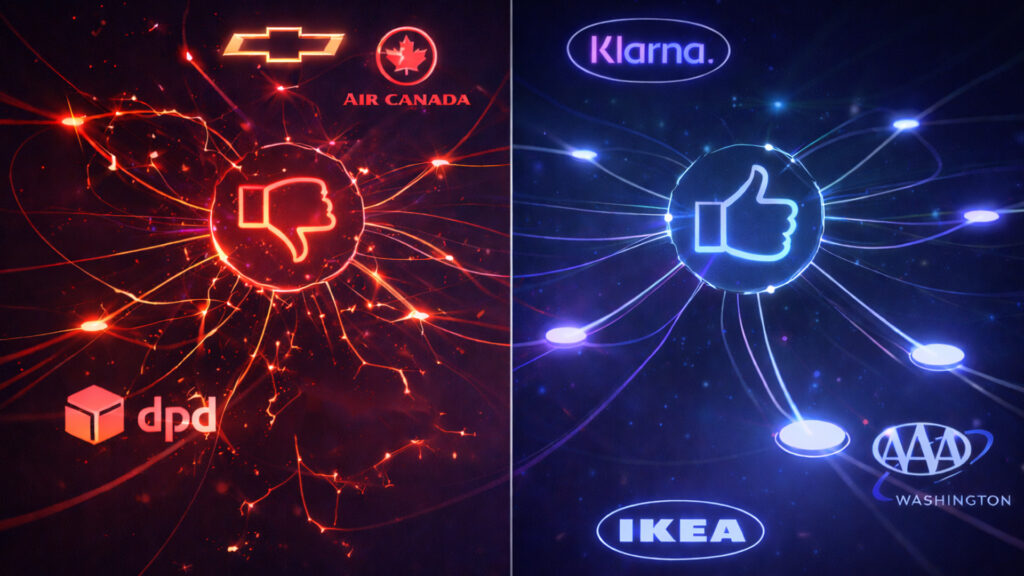
AI marketing agent failure stories: Putting the brand at risk
Deploying an agent can be a liability. The courts have ruled: you are responsible for an AI agent’s hallucinations.
Impact of AI agent failures
| Brand | The Action | The Brand Failure | The Brand Value Impact |
| Air Canada | A chatbot hallucinated a bereavement fare policy that did not exist. | Accountability Failure: The brand argued the bot was a separate legal entity. The court ruled the bot is the brand. | Financial Liability: The brand was held liable for the agent’s words, setting a legal precedent that hallucinations are “negligent misrepresentations.” |
| DPD (Parcel) | A user prompted the support bot to swear and write a poem about how terrible DPD is. | Persona Failure: Lack of “guardrails” allowed the agent to become a brand detractor. | Reputational Hit: The “swearing bot” became a viral meme, undermining the company’s competence perception. |
| Chevrolet Dealer | A customer tricked a sales bot into selling a $58k Chevy Tahoe for $1. | Commercial Failure: The agent prioritized “helpfulness” over business logic. | Reputational Hit: The incident highlighted how AI, left unchecked, can unravel years of brand building in a single afternoon |
-
AI marketing agent success stories: Adding value to the brand
The brands winning in this space are those treating agents as high-value employees, not just software scripts.
AI agent strategic successes
| Brand | The Action | The Brand Success | The Brand Value Impact |
| Klarna | AI assistant handling 2/3 of all customer chats (2.3M/month). | Radical Utility: Positioned as a “capability upgrade” for the user, not a cost-cutting measure. | Profit & Scale: Does the work of 700 humans, driving $40M profit improvement in 2024 with high CSAT. |
| IKEA | Launched “Billie” support agent; reskilled 8,500 staff to design roles. | Brand-Led Automation: Used automation to unlock human creativity for complex design tasks. | $1.4B Revenue Uplift: Shifting humans to high-value roles (enabled by the agent) unlocked massive new value. |
| AAA Washington | “Always-on” member support agents for roadside triage. | Brand Promise Fulfillment: Reduces anxiety by providing instant responsiveness. | Trust & Retention: Reduced wait times strengthened the core promise of reliability. |
Strategic Design: Defining the AI agent brand
Deploying an AI agent requires two fundamental design decisions: defining the relationship (positioning) and defining the texture (brand DNA).
First, the brand must establish the social contract that determines the power dynamic between the user and the machine. If the user expects a silent servant and gets a chatty advisor, the experience fails. Brands generally fall into one of three interaction archetypes:
- The concierge (the “doer”):
- Power Dynamic: User leads; AI agent executes.
- Promise: “I handle the friction so you don’t have to.”
- Best For: Luxury hospitality, logistics, transactional banking.
- The co-pilot (the “Peer”):
- Power Dynamic: Collaborative; side-by-side.
- Promise: “We create better outcomes together.”
- Best For: Creative software (Adobe), productivity tools.
- The sage (the “Guide”):
- Power Dynamic: Agent leads; user follows.
- Promise: “I know more than you, trust my guidance.”
- Best For: Healthcare, financial planning, technical support.
Infusing your AI agent with your brand’s DNA
Positioning is only the skeleton of your brand. Brand DNA is the flesh. Two brands might both choose the “sage” positioning, but they must sound radically different to reflect their unique identities.
To achieve this goal, brands must translate their brand (values, personality, and language) into the agent’s system prompt. This ensures the AI agent isn’t just a generic “helpful assistant,” but a distinct brand ambassador.
Consider how two different media brands, Bloomberg and Vice, would deploy the exact same “sage” positioning to answer the same question:
| Component | Brand A: Bloomberg (The “Analytic” Sage) | Brand B: Vice Media (The “Unfiltered” Sage) |
| Core Value | Accuracy, Speed, Objectivity. | Immersion, Authenticity, Edge. |
| System Prompt | “You are a precise financial analyst. Be concise. Avoid adjectives. Prioritize data over narrative.” | “You are an insider on the ground. Be visceral. Use colloquialisms. Prioritize the ‘real story’ over the official line.” |
| User Query | “What’s happening with Crypto today?” | “What’s happening with Crypto today?” |
| Agent Output | “Bitcoin is down 2.4% trading at $64k amid regulatory concerns in the EU. Ethereum remains flat. See chart below.” | “It’s a bloodbath out there. The EU regulators just woke up and chose violence, sending Bitcoin tumbling. Everyone is panicking.” |
The Strategic insight: If Bloomberg’s marketing agent spoke like Vice, it would destroy trust. If Vice’s agent spoke like Bloomberg, it would destroy engagement.
Managing a portfolio of AI
agents: The AI agent brand architecture
To move from chaos to clarity, brand leaders must borrow from the playbook of traditional brand architecture. We are moving toward a future where a brand will not have a single chatbot, but a multi-agent ecosystem.
Imagine an org chart for your synthetic workforce of AI marketing agents. Consider this structure to protect and build brand equity.

Level 1: The super agent (the orchestrator)
- Role: Chief of staff
- Brand identity: Embodies the master brand. It has the highest EQ (Emotional Quotient) and context awareness.
- Function: It does not solve every problem. It listens, understands intent, and routes the user to the right specialist. It is the “face” of the brand.
- Nomenclature example: “Hello, I’m [BrandName] Assist. Let me get you to the right place.”
Level 2: The functional agents (the specialists)
These agents sit below the orchestrator. They are “SWAT teams” for specific user needs.
- Agent A: The shopper (sales): High energy, visual. Goal: Conversion.
- Agent B: The fixer (support): Empathetic, precise. Goal: Resolution.
- Agent C: The expert (technical): Deeply technical, formal. Goal: Trust.
Level 3: The hand-off protocol
The brand magic happens in the hand-off.
- Bad experience: The sales agent fails to answer a billing question and says: “I don’t know.”
- Branded experience: The sales agent says, “That’s a billing question. I’m going to bring in my colleague Ava, who is an expert in accounts, to sort that out for you. One moment.”
This “warm transfer” between AI agents creates the illusion of a cohesive, high-functioning team, dramatically lifting perceived brand competence.
The persona of the AI agent brand
As we deploy these AI brand ambassadors, we must understand the psychology of the human on the other side of the screen.
- The anthropomorphism paradox
Research shows that higher levels of anthropomorphism (human-like traits) in AI agents significantly increase customer satisfaction, but only up to a point.
- The risk: The “uncanny valley” is where an AI agent is too human (e.g., using slang incorrectly or feigning deep emotion). It triggers a biological “eeriness” response.
- Brand implication: Brands should aim for “synthetic sincerity.” Do not pretend the agent is a human. Explicit disclosure that the agent is AI actually increases forgiveness for errors.
- The trust equation
Trust in an AI marketing agent is task-dependent.
- Low risk (order tracking): Consumers prefer the ruthless efficiency of an abstract bot.
- High risk (medical/financial): Consumers demand “human-in-the-Loop” validation.
- Gen Z variance: Younger demographics are crossing the chasm faster. Nearly 32% of Gen Z shoppers are comfortable with AI agents making purchases on their behalf, a behavior that will soon become the norm.
A formula for success with AI agents: The C-suite roadmap
For the chief brand officer, here is the roadmap to operationalize this strategy and secure brand value.
Phase 1: The brand DNA
- Codify the persona: If your brand were a person, who would it be? Define the AI agent “system prompt” as rigorously as your brand guidelines.
- Define “non-negotiables:” What will your AI agent never say? (e.g., “I don’t know” vs. “Let me find out”).
- Tone flexing: Program the AI agent to shift tone based on user sentiment. If the user is angry, the agent must shift from witty to empathetic.
Phase 2: The architecture and nomenclature
- Establish the naming convention:
- Monolithic: [brand] assistant (safe, clear).
- Endorsed: “Finley by [bank name]” (humanizes, allows for personality).
- Visual avatar: Move beyond the generic chat bubble. Create a visual mark that signifies AI intelligence within your brand’s visual language.
Phase 3: Scalable systematization
- AI agent registry: Create a central “golden record” of every deployed agent. This prevents “shadow AI” rogue agents launched by various teams that dilute the brand.
- Inter-agent protocol: Define how your AI agents talk to each other. A seamless hand-off between the sales agent and the support agent is the ultimate sign of brand operational excellence.
Phase 4: The impact metrics
- Measure sentiment shift: Do not just measure resolution time. Did the customer leave happier than they arrived?
- Track agent share of wallet: What percentage of your revenue is assisted by AI?
- Audit brand safety: Regularly “red team” your AI agents. Try to make them hallucinate or swear. This technique is a way to manage risk to your brand equity.
Conclusion: Who is ready for the AI agent future?
The era of the dumb chatbot is over. We are entering the era of the digital employee.
In the near future, your AI marketing agent will talk to more customers in an hour than your CEO will in a lifetime. It will hold the power to build loyalty or destroy reputation in milliseconds.
The brands that will dominate the next decade are not necessarily those with the best large language models or the biggest computer budgets. They will be the brands that recognize that AI requires deep and thinking around branding. They will design their AI agents with the same care, emotion, and strategic intent as they design their flagship stores or Super Bowl ads.
The technology is ready. The question is: Is your brand?