

Before we talk about brand architecture, first consider what brand is. Brand is not a name or a logo. Brand is a set of associations in people’s heads. These establish an emotional relationship with a company or product which leads people to prefer it over competitors. This preference causes them to buy it, generating an additional flow of revenues and profits, which the company wouldn’t have otherwise.
A strong brand allows companies to acquire new customers more easily, retain existing ones and get them to buy the company’s other products. A strong brand can command not only a volume premium (higher sales) but a margin premium (higher prices and higher profits). It enables the company to expand to new geographical markets and product categories. A strong brand attracts new employees and helps to retain existing ones.
All of this has very tangible financial results. Brand creates a competitive advantage and helps the company grow market share. This generates higher sales, higher profits. And it protects the business against risk. When times are tough, a strong brand can hold the business up and sustain performance, though this won’t last for ever. The stronger the brand, the more enduring the protection.
The result—businesses with strong brand command higher share prices. This chart tracks the performance of the strongest brands in the BrandZ Ranking of the Top 100 Most Valuable Brands, which I created back in 2006.
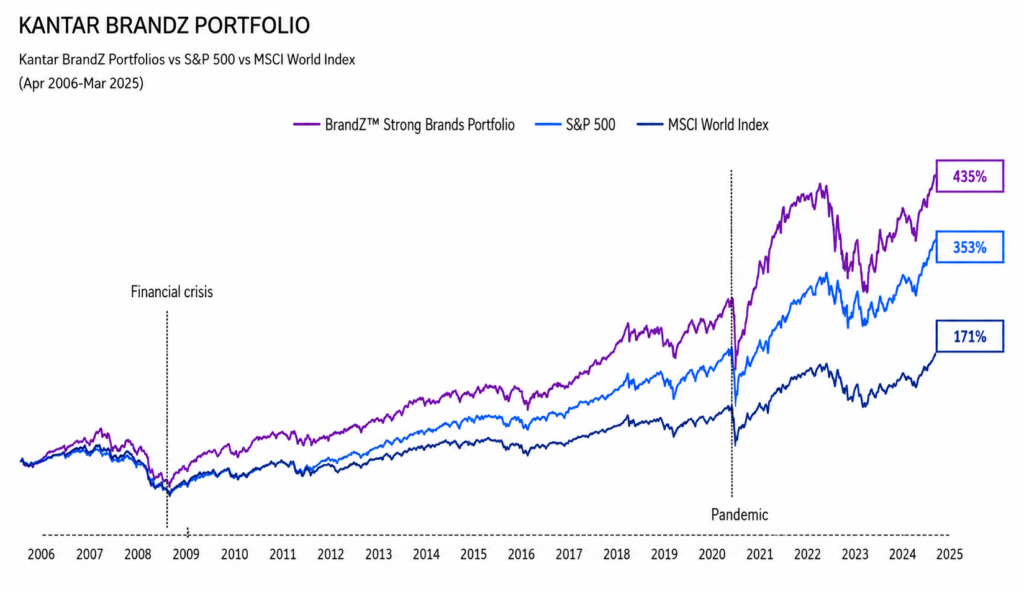
It shows that strong brands outperform major stock indices, consistently over time. They are worth investing in. Brand is a financial asset – for most corporations one of the most valuable. Intangible assets today represent 80-90% of the stock market’s value. Two of them, brand and intellectual property (IP) (patents, technologies, R&D) account for the overwhelming majority of value. Brand is estimated to form approximately 33% of total shareholder value. This is true for all types of business – consumer, B2B, across countries and categories.
Brand matters because it makes money.
What is brand architecture?
It is important to define brand architecture. The term is widely misused. Advertising agencies used it to describe hierarchies of communications messages. Branding companies apply it in terms of naming and logos. Companies use it to apply to the structure of their organization.
Brand architecture is not the organization structure of the company, which is concerned with how the company organizes itself internally, but is customer facing.
Brand architecture is the external face of the company, the structure through which it offers up its products and services to customers and potential customers. It explains the relationship of its products and services to each other, and to the corporation which owns them.
Why does brand architecture matter?
A good brand architecture enables customers to navigate through the company’s offer intuitively, to understand the relationships of products and services to each other and to the corporate brand.
It is very easy for brand architecture to get out of control. It’s a natural human tendency. Whenever someone develops something new, they feel a sense of pride and ownership. They want to brand and name it. If there isn’t very strong brand governance, brands start multiplying. This tendency is common to all companies, though it seems to be worst in tech. A new product is developed. The engineers, scientists or product managers order a pizza and have a team lunch to determine, “what shall we call it?”. I’ve seen it happen in Microsoft. Early in my brand consulting career, we sorted out a disastrously messy brand architecture for Steve Ballmer and Steve Jobs. We created order out of chaos across the warring groups that for so long defined Microsoft before Nadella. But no brand governance was put in place. And the moment we finished, it started happening again. Work to recreate a coherent brand architecture has been going on for years. Apple is generally one of the better ones, except for operating systems. What happened? The engineers developed exciting project names, which they got very attached to, and these seeped out into the marketplace. That’s why we had jaguars and pumas (then places in California, which was perhaps more deliberate).
It is critical to optimize brand architecture in a way that reflects how customers think about the products and makes it easy to buy them and put governance in place so the company sticks to it.
Why? An optimized brand architecture makes more money. It results in higher sales, greater profits, market share and business value growth.
Brand matters because it makes money. Brand architecture also matters because it makes money.