

by Ian Duncan
Reputation with a purpose
In one sense Jeff Bezos is right – your brand is ultimately the product of how you’re perceived, and you can’t control all of that, particularly with today’s level of scrutiny, 24/7 news environment and cyber- crime. In this context it’s tempting to see your corporate brand as a reputation defense mechanism.
While it’s true that your corporate brand should act as a buffer against the day-to-day mini-crises that can pop up you’ll need it to do more to help you actually grow the business. This likely means re-shaping your organization’s market permission, particularly if you want to expand into new types of market or businesses you’re not associated with today.
Amazon’s reputation for fast delivery has given it permission to expand into many markets (including healthcare), but there will be limits to where it can go – I’m not sure the world is ready (yet) for the Amazon Maternity Ward and Delivery Room!
I see 2 tasks for brand in building your organization’s reputation to transform and grow the business
- Creating room for growth by shaping the organization’s perceived relevance to match its growth ambitions. This is a job for positioning your brand in the minds of stakeholders – based on a core idea and the actions you take to deliver on it.
- Better connecting the dots between the organizations’ purpose and culture and the broader industry / societal issues and stakeholder agendas at play (eg; CSR, ESG). Organizations and CEOs often come under greater scrutiny when there’s an apparent disconnect between their commercial / shareholder agenda and attempts to be seen as upstanding corporate citizens.
Reputation vs. Brand: Tail wagging the Dog?
Managing corporate reputation typically falls under the remit of a corporate communications function which issues the annual report, briefs investors and analysts, arranges media interviews, runs social media pages, and manages crisis comms. These activities – with the addition of managing the visual brand identity – may be the entirety of what passes for corporate brand. The pitfalls of this are sadly only too common – here’s a few
- Ignoring employees: Getting your people on side is critical to a successful transformation (P=MV). Corporate and internal communications do not really tap in to engaging people at a deep and meaningful level and can be seen as being carefully edited versions of the truth.
- A disconnected narrative: “I see your press releases about the commitment to ESG and CSR but have no sense of how, or if, that ties to your business proposition to the market. My board needs clarity on this before they’ll consider signing a contact with your organization.”
- Competing messages: Corporate communications, employee communications, talent brand – there’s just too many competing agendas in businesses these days. The outside world is left to make sense of it all. You haven’t got time for this nonsense – so use brand (and the core idea) to project a coherent message that people can easily understand.
- Communications = crisis: “I only hear about your organization when there’s a crisis involving one of your businesses, so you seem to be an organization in…perpetual crisis…”
I think this is a case of the tail (reputation) wagging the dog (brand) and reflects the lack of understanding about brand. I’d argue that it makes more management sense to regard reputation as an outcome of brand and not the other way around. It is possible for a company to have a crappy reputation at a point in time – usually because someone has done something stupid that is eventually made right or forgiven – but still have a viable brand. However, if your brand becomes toxic, then it’s probably game-over, as staff, customers and sponsors rapidly desert something they don’t want to be associated with.
Below is an illustration of the contrast between a traditional inside-out / communications-centric view of reputation and a brand-led approach. So, as CEO, consider making corporate communications a function of a corporate brand team, rather than the other way around.
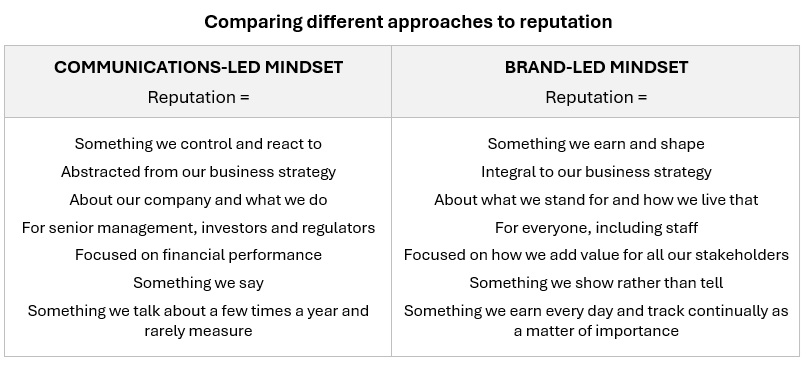
Brand as a vessel for corporate reputation
Whilst reputation is not really in your control, brand is an asset you own as CEO, and one you can proactively develop as part of your business strategy. And, in an era where consumers increasingly want to know who is behind the products they’re buying and what they stand for, your corporate brand needs to carry a reputation that represents your whole business.
Stakeholders need one joined-up narrative coming from your organization, not two (corporate comms vs. corporate brand), or three (corporate comms vs. corporate brand vs. “talent brand”). And, if brands can insulate an organization from the impact of reputational risk, it surely makes sense to pro-actively build that brand buffer, rather than rely on the latest crisis to determine your fate.
Your challenge as CEO is to build a reputation you can monetize and turn into growth. Your opportunity is to use your corporate brand as the “vessel” for that. Once you do that “reputation” goes from something amorphous and distributed – and therefore hard to get your arms around – to something more tangible, attached to your vision, which can be coherently managed and proactively developed.
Illustrative example – resetting reputation in ball-bearings
The example below illustrates contrasting ways the organization can present its story to the outside world, using many of the different storytelling elements you’d typically find on a corporate website.
The current story is there in parts, but it’s just not very compelling or likely to support expansion beyond ball-bearings. In contrast, the frictionless business story is more compelling and complete. It runs through everything and is more likely to challenge perceptions of the company. Consistency and coherence of message lend more “weight” to it so it’s more likely to stick. And the more employees see this idea brought to life the more they will believe it.
It’s OK for the story to be a little aspirational and ahead of the current reality in order to cultivate a level of expectation which maintains momentum. Too far ahead though and you risk falling flat on your face!
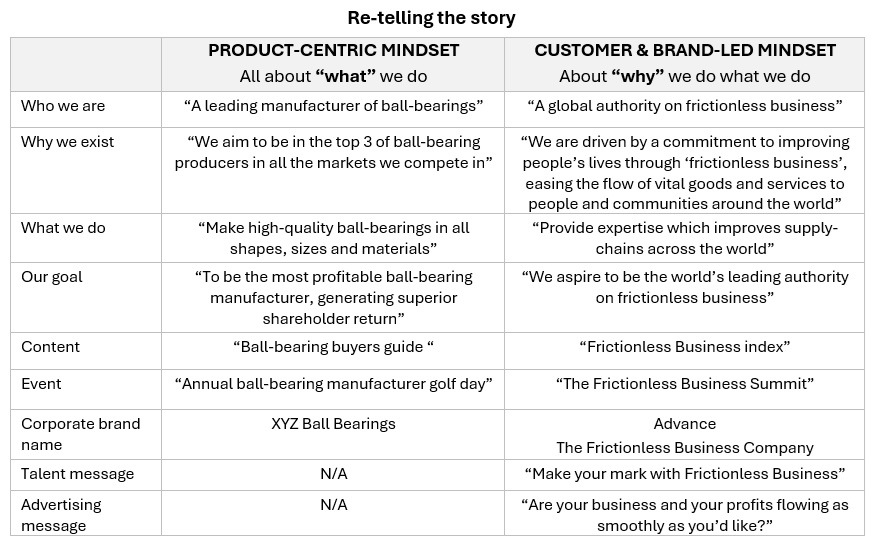
The CEO and her team have now been able to tackle the final part of fleshing out their corporate Brand in a way that supports transforming and growing the business. They now have a set of elements which bring Frictionless Business to life in a coherent way, including a way of articulating the idea to make the outside world sit up and take notice.
Key takeaways
- Reputation is an amorphous and intangible idea which is seen as a defensive thing for organizations to get involved with
- Whilst reputations (or good ones at least) are earned and valuable that should not mean that you cannot pro-actively shape them in a way that supports your growth agenda
- This goes beyond typical corporate communications to something that’s more about positioning the organization’s perceived relevance, in a way that provides market permission for your business to expand and grow
- Too often, management of the corporate brand resides within a corporate communications function – that’s a missed opportunity and a case of the tail wagging the dog. Brand should be the vessel for developing and managing your corporate reputation so that
- Reputation-building is proactive and in lock-step with your business ambition
- Reputation building is in lock-step with your change efforts in customer, platform, and culture