

by Sandeep Vasudevan
The ring is set. The 2026 Global Soft Power Index just dropped, and it confirms what brand strategists have whispered for years: We are no longer in a unipolar brand world.
This isn’t about politics; it’s about brand equity, market share, and narrative dominance. Here is the 6-round breakdown of the biggest clash in branding history.
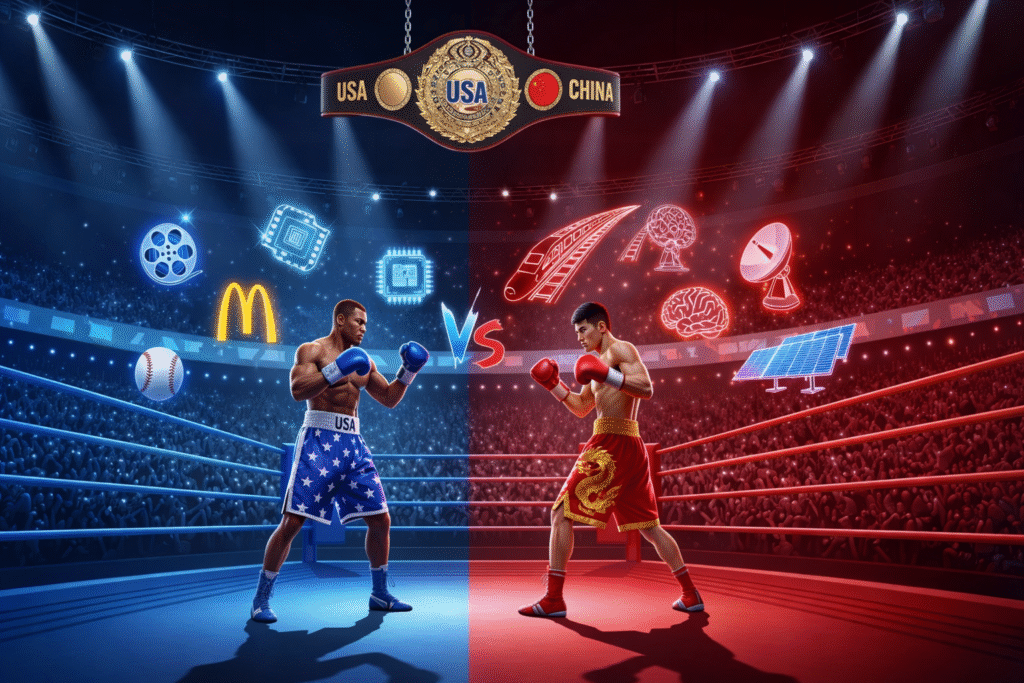
Round 1: Cultural soft power (the “cool” factor)
Brand USA leads with legacy assets. Hollywood and the American lifestyle remain potent. However, the U.S. recorded its steepest reputation decline in history this year (-4.6 points) as audiences decoupled “American culture” from American governance.
Brand China counters with the “TikTok Effect.” For the first time, a Chinese tech brand defines global trends. China’s lifestyle appeal rose 8 places, fueled by cultural exports that feel younger and more agile.
- Winner: Brand USA (by a nose). Nostalgia equity is a powerful shield, but it’s thinning.
Round 2: Innovation vs. the premium identity crisis
Brand USA swings with Silicon Valley. In 2026, the US still owns the generative AI narrative. If you want the brain,” you look to America.
Brand China responds by redefining premium. Look at the automotive sector: Ford and GM were built on utility and horsepower. In 2026, that promise is being disrupted. BYD and Xiaomi have shifted the brand moat from mechanical reliability to software intelligence.
The valuation hit: legacy US brands are seeing their brand contribution plummet in global markets. consumers won’t pay a badge premium for traditional American car if the digital brain is two generations behind the Chinese competition.
- Winner: Brand China. They’ve moved from copycat to category king by making intelligence the new luxury.
Round 3: Reliability and the flagless brand strategy
Brand USA takes a heavy hit. Its reputation rank plummeted 11 spots. International backlash to “America First” policies has created a brand trust deficit.
Brand China is winning through nationality-agnostic branding. Brands like TikTok and Temu have masterfully decoupled their user experience from their parent origin. They don’t sell “China.” They sell dopamine and efficiency. Meanwhile, Western brands like Apple are shifting their narrative from California to global citizen just to survive.
- Winner: Brand China. In a polarized world, the brand that belongs everywhere is the one that survives anywhere.
Round 4: economic weight and the compute moat
Brand USA lands a massive financial hook. US brands comprise 45% of total global brand value ($6.4 trillion). Apple, Microsoft, and NVIDIA are trillion-dollar moats.
Brand China is proving that brute force is a failing moat. The launch of DeepSeek-R1 shifted the narrative from “Who has the most GPUs” (USA) to “Who has the most intellectual efficiency” (China). When you can match a western model at 5% of the training cost, your hardware moat isn’t a strategy, it’s a capital liability.
- Winner: Brand USA. The US still holds the reserve currency of brand value, but the vault is under siege.
Round 5: Agility and speed to market
Brand USA is struggling with incumbent inertia. The US approach to business is often rigid and focused on quarterly earnings.
Brand China wins on operational agility. Chinese brands have reduced product development cycles by 40%. They operate with ecosystem brand architecture (like Xiaomi), flooding new categories before western brands finish their focus groups.
- Winner: Brand China. Speed is the new quality.
Round 6: The human capital engine (the genius pipeline)
Brand USA relies on a free market for talent, attracting global talent through immigration.
Brand China has industrialized the creation of genius. They graduate 5 million STEM majors annually (vs. 500,000 in the U.S.). Their genius classes funnel 100,000 gifted teens into elite streams every year, solving high-level engineering problems by age 16.
- Winner: Brand China. You can’t out-innovate a 10-to-1 talent ratio.
THE FINAL VERDICT: A split decision
- Scorecard: Brand China wins on utility, velocity, and talent pipeline. Brand USA wins on legacy value, tech moats, and cultural reach.
The Executive “So What?”
The 2026 champion isn’t the most powerful brand, it’s the most relevant. The US is currently a luxury heritage brand facing a disruptive challenger.
The Recommendation: Stop assuming heritage is an impenetrable moat.
- Re-architect for neutrality: If your brand identity is tied to national flags, you are inheriting sovereign risk. Move toward a nationality-agnostic brand strategy where your brand’s home is the customer promise, not a map.
- Pivot from hardware to brainware: In the new brand valuation models, mechanical excellence is a commodity. reinvest your brand equity into software Intelligence and UX. If your brand doesn’t own the smart layer, your badge is just a sticker on someone else’s technology.
- Protect the brand contribution: As China floods markets with 10x the talent and 2x the speed, your only defense is emotional differentiation. Stop competing on features (you will lose); start competing on the intangible narrative that only a brand can sustain.
Are you leveraging a legacy premium that’s expiring? Or are you building a brand that wins on intelligence equity? the bell has rung. Which side of the ring are you on?