

By Hecson Olguin
Elon Musk has a CEO brand that may be one of SpaceX’s most valuable assets. We have entered an era where a company’s value is increasingly influenced not only by its products or financial performance, but by the strength of its founder’s or leader’s brand. From Steve Jobs at Apple to Jensen Huang at NVIDIA and Sam Altman at OpenAI, investors are placing growing value on leaders capable of shaping industries as much as companies. No CEO demonstrates this phenomenon more dramatically than Elon Musk.
Wall Street has witnessed thousands of IPOs. Some introduced revolutionary companies, while others quickly faded into history. But SpaceX’s public debut belongs to a category of its own.
SpaceX raised approximately $75 billion in its IPO, and its market capitalization reached almost $3 trillion almost immediately, making it one of the most valuable companies ever to trade on public markets. It has fallen a little but is still around $.6 trillion.
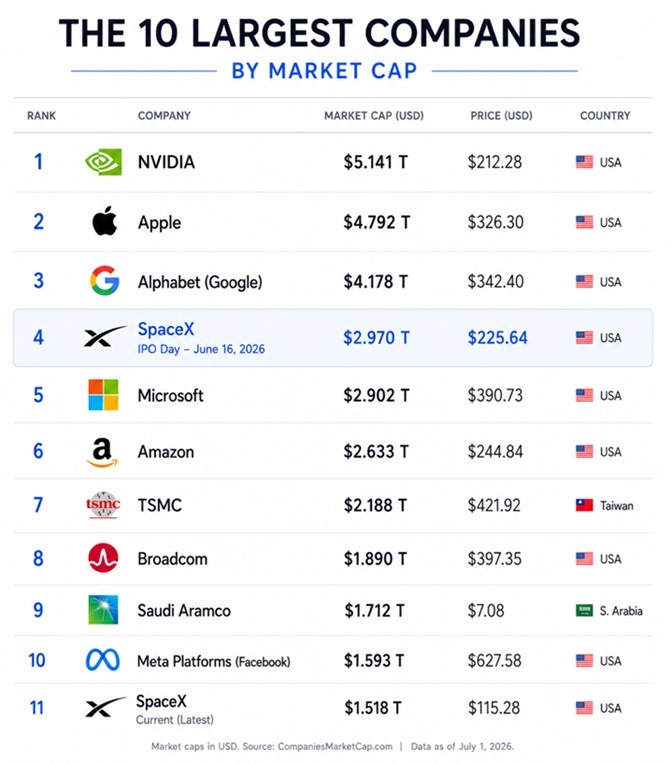
SpaceX’s IPO wasn’t remarkable simply because it created another multi-trillion-dollar company. It demonstrated a huge rise in the price premium investors are willing to pay for brand.
Revenue, technology, and market leadership explain much of SpaceX’s valuation. But they don’t explain all of it. The remaining premium reflects confidence in something far harder to measure: Elon Musk’s CEO brand.
The CEO brand defines the company brand
Branding SpaceX as “a rocket company” is like branding Amazon as an online bookstore.
Technically true but completely missing the point. It latches on to the original business of the company (remember, at one time, Amazon only sold books?) without looking at where it is going.
One of the greatest powers of a CEO brand is its ability to shape how people perceive an entire company. The CEO brand can give a company permission to expand to new categories. Elon Musk has never positioned SpaceX as a business that simply launches rockets. He has positioned it as the company building humanity’s future in space.
Today, the SpaceX brand is:
- the global leader in commercial launch services
- the operator of Starlink, the world’s largest satellite internet network
- a critical partner to the U.S. government and defense sector
- an infrastructure company supporting AI and global connectivity
- and the company most aggressively pursuing humanity’s expansion beyond Earth
Each of these businesses could justify a substantial valuation on its own. But the SpaceX brand represent something even larger. It has become synonymous with technological leadership, engineering excellence, global connectivity, and the ambition to achieve what once seemed impossible.
Those expectations didn’t emerge from a marketing campaign. They were built through years of Elon Musk consistently communicating his vision. His CEO brand transformed SpaceX from the rocket company it indeed was originally into a symbol of what’s possible.
As a result, investors aren’t valuing only the businesses SpaceX operates today. They’re valuing the future opportunities they believe Elon Musk can create next. That’s the power of a CEO brand: it expands what people believe a company is capable of becoming.
CEO brands transfer trust before results
One of the most powerful characteristics of a great brand is its ability to transfer trust. Every new company that Elon Musk launches begins with something most startups spend years trying to build: Credibility.
Investors, employees, partners, and customers were already paying attention because of the founder behind the business. This is the principle behind the world’s strongest corporate brands. When Apple launches a new product, millions assume a certain level of quality before they ever use it. When Nike enters a new category, consumers expect innovation before seeing the product. Why? These expectations were set by their founders – Steve Jobs for Apple and Phil Knight at Nike. Nike’s recent failure to deliver on the brand its founder created is why it is today a company in turnaround.
The Elon Musk brand works in the same way. His reputation transfers trust from one venture to the next. Every successful company strengthens the next one. That’s exactly what powerful brands do. They reduce uncertainty before results exist.
The CEO brand premium
Imagine SpaceX had identical revenue, identical technology, identical government contracts, and identical growth prospects, but was led by an unknown CEO. Would the market still value it above $2 trillion? Almost certainly not.
The CEO brand difference is what investors are really paying for. The CEO brand premium isn’t found on SpaceX’s balance sheet, yet it may be one of the company’s most valuable assets. Tesla was never valued like a traditional automaker. SpaceX isn’t being valued like a traditional aerospace company.
While established aerospace and defense companies often trade at relatively modest revenue multiples, SpaceX sits in a category of its own because investors are pricing more than future cash flows. They’re pricing the probability that Elon Musk creates something else.
Whether that’s lunar logistics, autonomous robotics, AI infrastructure, or interplanetary transportation almost becomes secondary. That’s what the Elon Musk CEO premium represents.
Strong CEO brands don’t require universal approval
One of the biggest misconceptions about branding is that strong brands must be universally liked.
Elon Musk’s CEO brand proves the opposite.
He is arguably one of the most polarizing business leaders in the world. His political opinions, posts on X, public disputes, and unconventional communication style regularly generate headlines and sometimes trigger sharp reactions from customers, advertisers, and investors.
Tesla has experienced multiple periods where Musk’s comments or actions created short-term pressure on the company’s stock. His 2018 “funding secured” tweet led to regulatory action and sharp market volatility. More recently, political controversies have periodically affected investor sentiment and sales in certain markets. In Europe, people were throwing paint at Telsa cars.
Yet time after time, investors have largely returned their focus to Tesla’s execution, innovation, and long-term growth potential. Why? Because strong brands aren’t built on universal agreement. They’re built on recognition, credibility, and conviction.
Nike has critics. Apple has critics. Elon Musk certainly has critics. But none of those brands depend on everyone liking them. They depend on enough people believing in what they represent. That’s an important distinction.
Controversy may create short-term volatility. Strong brands creates long-term resilience.
The future belongs to CEO brands
SpaceX’s IPO wasn’t simply a milestone for the aerospace industry. It demonstrated that a founder’s brand can become one of the most valuable assets a company owns. For decades, businesses invested heavily in building consumer brands while treating executive visibility as secondary. Today’s markets suggest that equation is changing.
The strongest companies of the next decade may possess two equally valuable assets: a corporate brand that customers trust and a leadership brand that investors believe in.
In the industrial age, companies were valued for the factories they built. In the digital age, they were valued for the software they wrote. In the age of artificial intelligence, they may increasingly be valued for the people capable of imagining, and executing, what comes next. The example of Apple and Nike shows that the CEO brand value premium can outlast the company’s founder.
The SpaceX brand may be the clearest evidence yet that, in modern markets, brand isn’t just a marketing asset. It’s a financial one. And sometimes, the most valuable brand a company owns isn’t its logo.
It’s the person leading it.